


Newsletters | Request Trial | Log in | Advertise | Digital Issue   |   Search
  • Upstream
  • Midstream & Downstream
  • Gas & LNG
  • Trading & Markets
  • Corporate & Finance
  • Geopolitics
  • Podcasts
Search
Related Articles
Outlook 2026: How critical mineral partnerships are shaping ASEAN’s energy transition
The global race for critical minerals has become a defining feature of energy geopolitics, presenting the ASEAN region with both opportunity and risk
Southeast Asian nations poised for crucial decade
Future development prospects are mixed across the energy-hungry region
Southeast Asia counting on carbon capture
The region’s shift from coal- to gas-fired generation will require additional strategies to meet ambitious carbon targets
Shell divests Philippine gas stake
Shell has agreed to sell its stake in Malampaya, the Philippines’ largest productive gas field, as the major continues an aggressive programme of divestments
New LNG markets prove tough nuts to crack
Floating storage and regasification has reduced entry barriers for aspiring LNG importers. But opening up a new market remains a tricky business
Philippine LNG sector picks up speed
As much as 10.5mn t/yr of regasification capacity could be coming online in 2022
Asian LNG demand set to rebound rapidly
Both the data and personal experience point to a very quick resumption of the region’s demand growth
South and Southeast Asia to drive LNG demand growth
The region needs LNG to power developing economies
Independents seize Southeast Asia M&A initiative
As the majors exit, ambitious small and mid-sized entrants are challenging NOCs' dominance in the asset purchase market
Philippines LNG projects pass significance test
The island nation's government awards certificates to two more planned import facilities
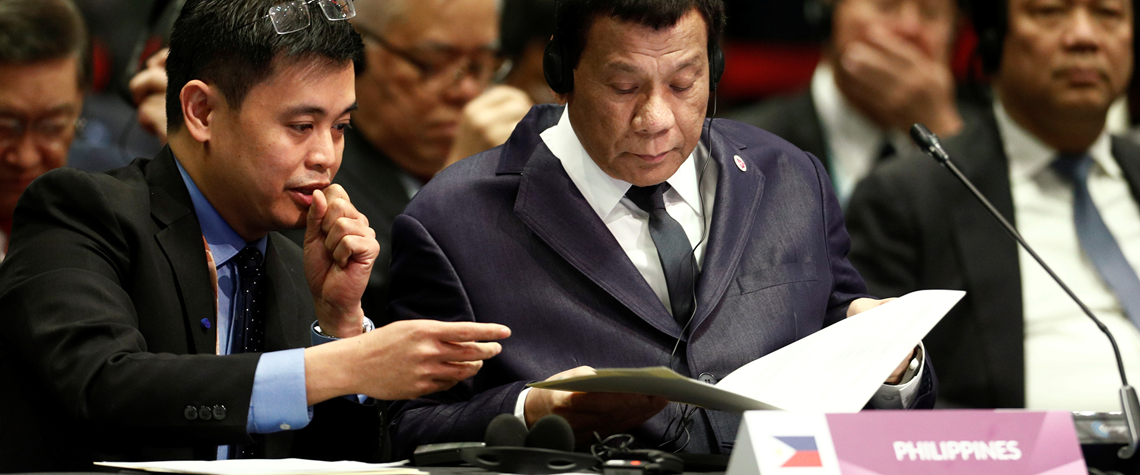
Looking to China: President Rodrigo Duterte announced the executive order in May
Philippines
James Gavin
9 July 2019
Follow @PetroleumEcon
Forward article link
Share PDF with colleagues

Manila opens the door to Chinese E&P

An executive order has reduced the constraints on Philippines’ state oil company working with third parties on oil and gas deals

An executive order from Philippines President Rodrigo Duterte that relaxed the rules on oil and gas exploration should make it easier for the government to cement its recent outreach to China, as it opens exploration blocks in a bid to reverse a precipitous decline in production. Executive Order 80, issued in late May, reverses a previous ruling from 2006 that prevented the Philippine National Oil Company Exploration Corporation (PNOC-EC) from directly farming out its acreage. From now on, third parties can participate in service contracts awarded by the government to PNOC-EC, the upstream arm of state-owned Philippine National Oil Company, without the need for public bidding.PNOC-EC has bee

Also in this section
Explainer: Iran’s indispensable energy role
16 January 2026
The country’s global energy importance and domestic political fate are interlocked, highlighting its outsized oil and gas powers, and the heightened fallout risk
Oil’s tanker transformation
16 January 2026
The global maritime oil transport sector enters 2026 facing a rare convergence of crude oversupply, record newbuild deliveries and the potential easing of several geopolitical disruptions that have shaped trade flows since 2022
Letter from the US: The curse of strong energy exports
Opinion
15 January 2026
Rebuilding industry, energy dominance and lower energy costs are key goals that remain at odds in 2026
Venezuela mismanaged its oil, and US shale benefitted
14 January 2026
Chavez’s socialist reforms boosted state control but pushed knowledge and capital out of the sector, opening the way for the US shale revolution

Share PDF with colleagues

COPYRIGHT NOTICE: PDF sharing is permitted internally for Petroleum Economist Gold Members only. Usage of this PDF is restricted by <%= If(IsLoggedIn, User.CompanyName, "")%>’s agreement with Petroleum Economist – exceeding the terms of your licence by forwarding outside of the company or placing on any external network is considered a breach of copyright. Such instances are punishable by fines of up to US$1,500 per infringement
Send

Forward article Link

Send
Sign Up For Our Newsletter
Project Data
Maps
Podcasts
Social Links
Featured Video
Home
  • About us
  • Subscribe
  • Reaching your audience
  • PE Store
  • Terms and conditions
  • Contact us
  • Privacy statement
  • Cookies
  • Sitemap
All material subject to strictly enforced copyright laws © 2025 The Petroleum Economist Ltd
Cookie Settings
;

Search
