


Newsletters | Request Trial | Log in | Advertise | Digital Issue   |   Search
  • Upstream
  • Midstream & Downstream
  • Gas & LNG
  • Trading & Markets
  • Corporate & Finance
  • Geopolitics
  • Podcasts
Search
Related Articles
China’s secure energy transition
Alongside a rapid continued build-out of renewables, China’s latest five-year plan stresses the value of domestic hydrocarbon production for energy security and calls for increased Russian gas imports
Venezuela already making oil comeback
The government is taking important steps to revive domestic production, lift investment and benefit from the geopolitical crisis even if more needs to be done in the longer term
How Russia gains from the Hormuz supply shock
The US may be systemically stripping Russia of key geopolitical allies, but Moscow can reap rewards from the Hormuz crisis, both in the short and long term
Letter from Asia: The nuanced India-Russia oil picture
The South Asian consumer’s next move could tighten the Middle East oil market overnight
China’s new oil position
OPEC, upstream investors and refiners all face strategic shifts now the Asian behemoth is no longer the main engine of global oil demand growth
Explainer: Inside China’s crude oil stockpiling black box
Energy security continues to evolve as a strategic priority amid growing geopolitical tensions highlighted by increased volumes, a new energy law and persistent secrecy
Arctic LNG 2 adds Arc7 to its shadow fleet
Having found a steady buyer in China for its sanctioned gas, the Russian project is positioned for nearly year-round operations, yet its 11-vessel ‘shadow fleet’ is still insufficient to achieve anywhere near capacity utilisation.
Venezuela upends global heavy crude market
The ripple effects of US refiners switching to Venezuela grades will be felt from Canada to China and everywhere in between
Venezuela mismanaged its oil, and US shale benefitted
Chavez’s socialist reforms boosted state control but pushed knowledge and capital out of the sector, opening the way for the US shale revolution
Venezuela’s true oil potential
The Latin American producer’s crude prospects rely on a multi-pronged approach where even the relatively easy wins will take considerable time, effort and cost
Venezuela Russia China
Jose La Rosa Reyes
1 February 2021
Follow @PetroleumEcon
Forward article link
Share PDF with colleagues

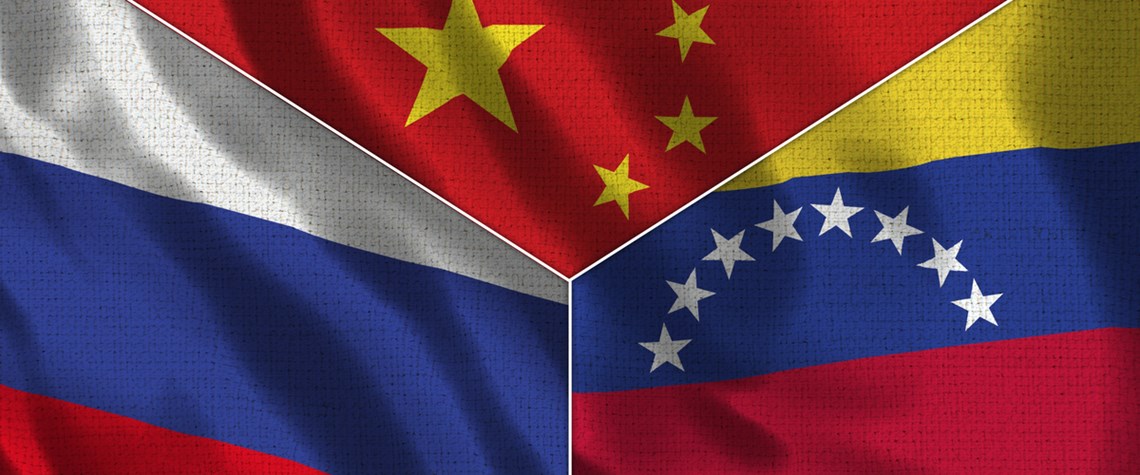
Venezuela’s allies choose divergent paths

Support from strategic partners Russia and China has helped the Latin American regime endure punishing economic sanctions. But over time their approaches have begun to deviate significantly

Venezuelan president Nicolas Maduro’s capacity to retain power depends on multiple factors: an ideologically divided political opposition, strong loyalty among higher ranks of the country’s military and an efficient authoritarian apparatus built to persecute and crush dissent. But, beyond these domestic factors, both China and Russia have been key allies for Venezuela, providing an economic lifeline for the beleaguered former oil giant. Venezuela’s oil industry is far from its heyday. Years of mismanagement, deficient basic services and economic sanctions have all taken their toll. Daily production fell from about 3mn bl/d in 2010 to 362,000bl/d in Q3 last year, the lowest level since 1940.

Also in this section
Gas growth cools in 2025
14 April 2026
The GECF has warned it may revise its projections for demand this year downwards in light of conflict in the Middle East, although it maintains its forecasts for 2027 and onwards
OPEC+’s 11m b/d March production collapse
13 April 2026
Petroleum Economist analysis highlights sharp shift from crude oversupply to market deficit, with Iraq and Kuwait badly affected and key producers Saudi Arabia and the UAE also seeing output sharply lower
Galkynysh goes fourth
13 April 2026
Turkmenistan is moving ahead with a modest expansion of the giant Galkynysh field to sustain gas deliveries abroad, but persistent delays to other key pipeline projects and geopolitical risks continue to constrain its export ambitions
The UK’s problematic power price
13 April 2026
Expensive electricity has forced out swathes of energy-intensive industry and now threatens the country’s ability to attract future investment in datacentres and the digital economy

Share PDF with colleagues

COPYRIGHT NOTICE: PDF sharing is permitted internally for Petroleum Economist Gold Members only. Usage of this PDF is restricted by <%= If(IsLoggedIn, User.CompanyName, "")%>’s agreement with Petroleum Economist – exceeding the terms of your licence by forwarding outside of the company or placing on any external network is considered a breach of copyright. Such instances are punishable by fines of up to US$1,500 per infringement
Send

Forward article Link

Send
Sign Up For Our Newsletter
Project Data
Maps
Podcasts
Social Links
Featured Video
Home
  • About us
  • Subscribe
  • Reaching your audience
  • PE Store
  • Terms and conditions
  • Contact us
  • Privacy statement
  • Cookies
  • Sitemap
All material subject to strictly enforced copyright laws © 2025 The Petroleum Economist Ltd
Cookie Settings
;

Search
