


Newsletters | Request Trial | Log in | Advertise | Digital Issue   |   Search
  • Upstream
  • Midstream & Downstream
  • Gas & LNG
  • Trading & Markets
  • Corporate & Finance
  • Geopolitics
  • Podcasts
Search
Related Articles
Outlook 2026: Renewal and growth in Nigeria’s upstream sector
Government reforms are restoring investor confidence in the country’s oil and gas industry
Nigeria aligns independents with NNPC
OPEC governor Ademola Adeyemi-Bero explains Nigeria First policy as the African producer looks to drive production back above 2m b/d and play crucial role in OPEC
Nigeria charts ‘just transition’ course for NOCs
OPEC Governor Ademola Adeyemi Bero argues that only by prioritising oil and gas through partnerships with IOCs and stable OPEC market management can NOCs fulfil their pivotal global role
Shell offshore deal signals Nigerian gas coming of age
FID on the HI development suggests the country’s chronically under-exploited gas reserves are beginning to be properly exploited
Russia’s fuel crisis: Difficult but not catastrophic
International and opposition media claim that two-fifths of the country’s refining capacity is offline, but the true situation is not so dire
Nigerian oil theft: Breakthrough or false dawn?
Progress on fixing Nigeria’s long-term oil pipeline theft problem needs to be supported by a wider strategy to avoid relapse
California refiners dreaming of heyday
US downstream sector in key state feels the pain of high costs, an environmental squeeze and the effects of broader market trends
Mars attacks US oil industry
Crude quality issues are an often understated risk to energy security, highlighted by problems at a key US refinery
Nigeria bullish about oil recovery
Efforts to restructure and boost investment appear to be working, but doubts remain about the plan to almost double crude production by 2030
The death knell for UK energy security
The end of Grangemouth and Lindsey oil refineries marks a worrying trend across Europe amid cost and transition pressures
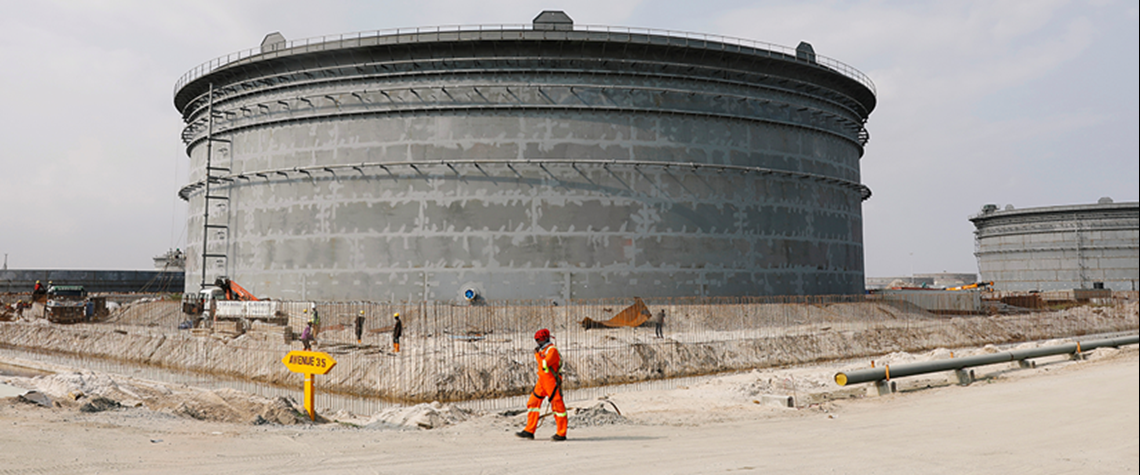
Storage tanks at Dangote oil refinery in Nigeria
Nigeria Refining
Ian Simm
20 December 2021
Follow @PetroleumEcon
Forward article link
Share PDF with colleagues

Nigeria poised for refining renaissance

The country is set to end a lengthy period in the doldrums with the launch of several small facilities

Nigeria remains reliant on imports to satisfy refined product demand despite being one of Africa’s top oil producers. While downstream capacity has been underutilised for a long time, the situation worsened when state-owned NNPC took its full 445,000bl/d slate offline in 2019 for long-overdue rehabilitation. At present, the 5,000bl/d modular unit developed by Nigerian independent Waltersmith Petroman at Ibigwe is the country’s only operational refinery. But with recent progress on ambitious downstream development plans, Nigeria hopes to usher in an era of fuel independence and, eventually, exports. Six new modular refineries are expected to begin commissioning within the next few months. The

Also in this section
Explainer: Iran’s indispensable energy role
16 January 2026
The country’s global energy importance and domestic political fate are interlocked, highlighting its outsized oil and gas powers, and the heightened fallout risk
Oil’s tanker transformation
16 January 2026
The global maritime oil transport sector enters 2026 facing a rare convergence of crude oversupply, record newbuild deliveries and the potential easing of several geopolitical disruptions that have shaped trade flows since 2022
Letter from the US: The curse of strong energy exports
Opinion
15 January 2026
Rebuilding industry, energy dominance and lower energy costs are key goals that remain at odds in 2026
Venezuela mismanaged its oil, and US shale benefitted
14 January 2026
Chavez’s socialist reforms boosted state control but pushed knowledge and capital out of the sector, opening the way for the US shale revolution

Share PDF with colleagues

COPYRIGHT NOTICE: PDF sharing is permitted internally for Petroleum Economist Gold Members only. Usage of this PDF is restricted by <%= If(IsLoggedIn, User.CompanyName, "")%>’s agreement with Petroleum Economist – exceeding the terms of your licence by forwarding outside of the company or placing on any external network is considered a breach of copyright. Such instances are punishable by fines of up to US$1,500 per infringement
Send

Forward article Link

Send
Sign Up For Our Newsletter
Project Data
Maps
Podcasts
Social Links
Featured Video
Home
  • About us
  • Subscribe
  • Reaching your audience
  • PE Store
  • Terms and conditions
  • Contact us
  • Privacy statement
  • Cookies
  • Sitemap
All material subject to strictly enforced copyright laws © 2025 The Petroleum Economist Ltd
Cookie Settings
;

Search
