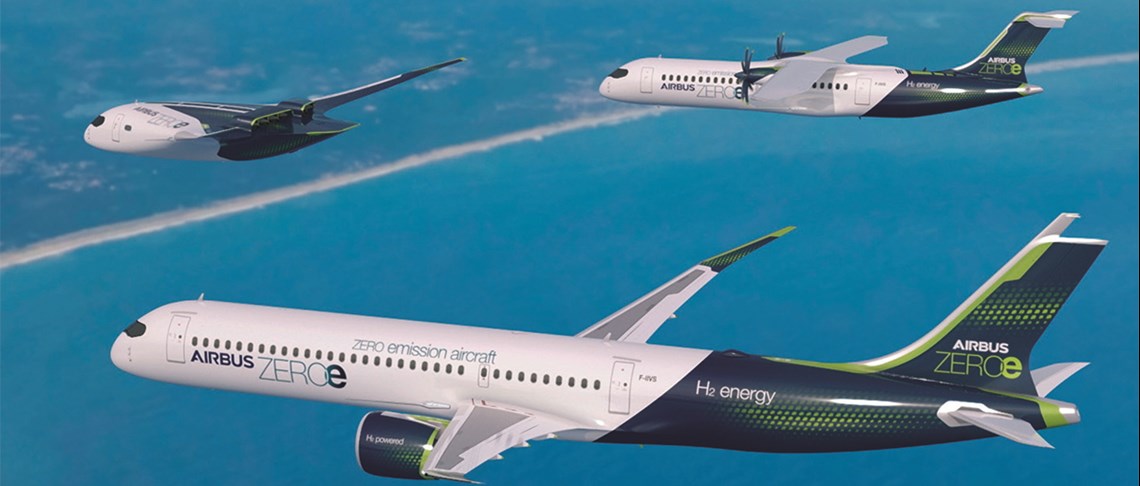
Airbus hydrogen plane concepts
Airbus bets billions on hydrogen-powered planes
European manufacturer has touted various potential short- and medium-range designs, but the simplest and smallest seem most viable amid technological and demand uncertainty
Airbus believes hydrogen-powered planes are well-suited to cutting emissions from intra-continental air travel, but longer-range aircraft will rely on sustainable aviation fuel to reduce their environmental impact, a company spokeswoman tells Hydrogen Economist. Last September, Airbus unveiled three ZEROe hydrogen-powered concept planes that it claims could enter commercial service in 2035. The turboprop concept could fly up to 100 passengers to a range of c.1,000 nautical miles, while the turbofan and blended-wing configurations would have double the capacity and range. Airbus revealed another potential design in December in which a plane would have three, eight-bladed engines on each wing.

Also in this section
1 April 2026
Multiple projects have been scrapped and valuations have nosedived, but the IEA says hydrogen is no passing fad
25 March 2026
The Middle East energy shock has highlighted the value of France’s unique potential to deploy nuclear-powered electrolysers
18 March 2026
The second fossil-fuel price shock in four years can be a much-needed catalyst for investment in the sector
9 March 2026
Hydrogen has not stalled in the UK because the technology does not work. The problem is that the system around it does not yet move at the speed required