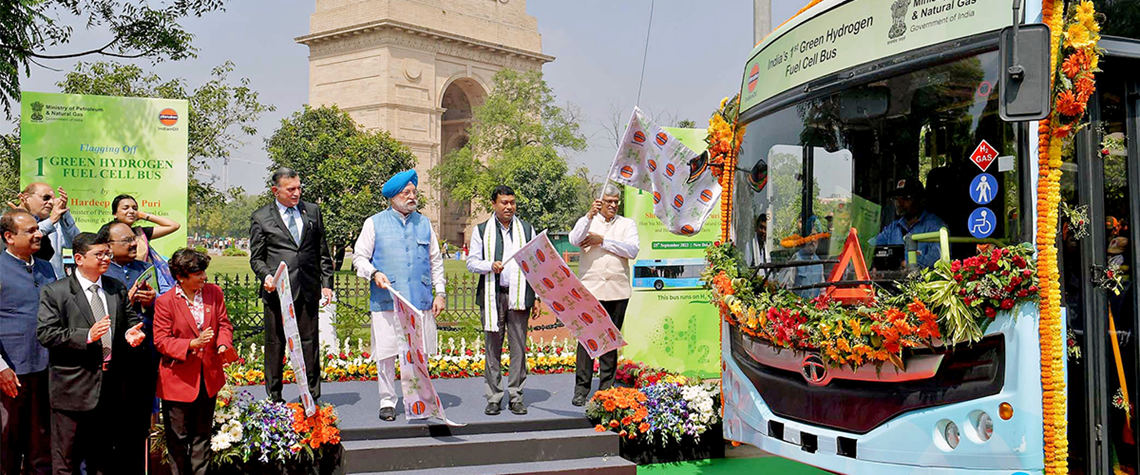
India’s minister for petroleum and natural gas, housing and urban affairs, Hardeep Singh Puri flags off India’s first green hydrogen fuel-cell bus
Letter from India: Turning hydrogen hub dreams into reality
Building green hydrogen ports and lower production costs key to becoming global exporter
Transitioning to hydrogen as a sustainable fuel for future generations, replacing fossil fuels, requires hydrogen production, storage, pipelines and dispensing stations to be expanded to create widely distributed networks in order for the fuel to become common and popular. It involves huge infrastructure development across all segments of the hydrogen economy. Several countries and multinational corporates have adopted a strong commitment to the target of net-zero emissions and have taken up green hydrogen/ammonia projects, including hubs for domestic distribution and export. 306mt/yr – Volume of green hydrogen needed for net-zero world, according to IEA One-hundred and ninety-eight

Also in this section
1 April 2026
Multiple projects have been scrapped and valuations have nosedived, but the IEA says hydrogen is no passing fad
25 March 2026
The Middle East energy shock has highlighted the value of France’s unique potential to deploy nuclear-powered electrolysers
18 March 2026
The second fossil-fuel price shock in four years can be a much-needed catalyst for investment in the sector
9 March 2026
Hydrogen has not stalled in the UK because the technology does not work. The problem is that the system around it does not yet move at the speed required