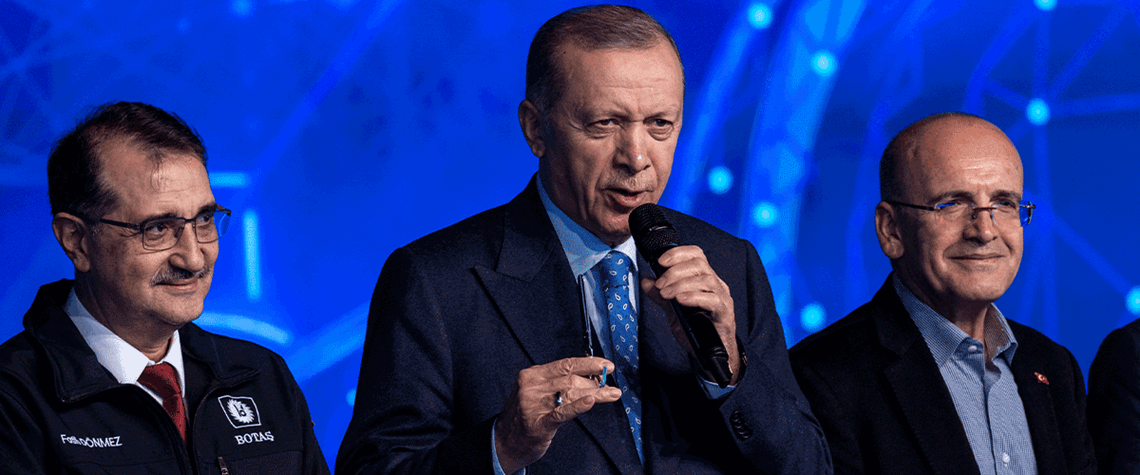
Turkish president Erdogan with energy minister Donmez (left)
Turkey outlines hydrogen plans
The government prioritises replacing imported gas in the domestic energy system in a broad, heavily backloaded strategy
Ankara published its long-promised hydrogen strategy in late January, outlining in broad terms the fuel’s envisioned place in the domestic energy mix over the next three decades and the policies required to put it there. Ambitious long-term targets are set for scaling up capacity and reducing the cost of green hydrogen. Yet the plans are short on specifics, heavily backloaded—the main advances coming well into the 2030s and beyond—and implicitly confirm that hydrogen development will be a relatively low priority within the country’s complex energy policymaking rubric in the near term. Turkish energy policy is and will remain driven above all by the need to ensure security of supply given a p

Also in this section
1 April 2026
Multiple projects have been scrapped and valuations have nosedived, but the IEA says hydrogen is no passing fad
25 March 2026
The Middle East energy shock has highlighted the value of France’s unique potential to deploy nuclear-powered electrolysers
18 March 2026
The second fossil-fuel price shock in four years can be a much-needed catalyst for investment in the sector
9 March 2026
Hydrogen has not stalled in the UK because the technology does not work. The problem is that the system around it does not yet move at the speed required