


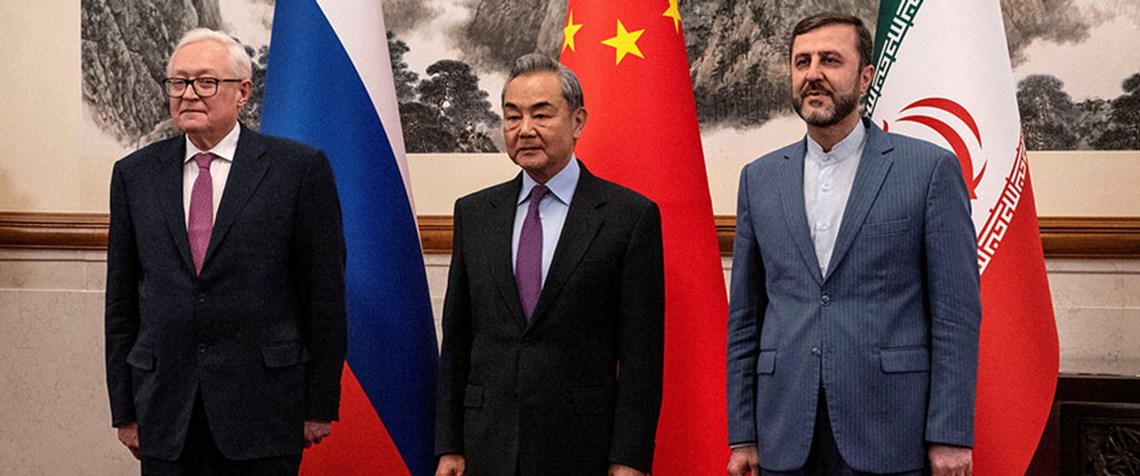
Russian Deputy Foreign Minister Sergey Ryabkov (left) Chinese Foreign Minister Wang Yi (centre) and Iranian Deputy Foreign Minister Kazem Gharibabadi at a meeting in March
Letter from Iran: High-stakes nuclear diplomacy
Iran’s oil is caught in the crosshairs of support from China and Russia and US maximum pressure, with options becoming more and more limited
Iran's nuclear talks have once again made headlines as US President Donald Trump has threatened Tehran with a deadline—either reach an agreement or face military action. His remarks have been met with strong reactions from Iranian officials, who have emphasised they will not negotiate under pressure. Ayatollah Khamenei, Iran's supreme leader, has rejected talks with the US, deeming it a "bullying" government. He also described negotiations with the US as unwise and dishonourable, expressions that make any form of negotiation particularly challenging for Iran’s moderate government. It will be China that decides whether to preserve Iran and defend Chinese companies dealing with the Middl

Also in this section
13 April 2026
Petroleum Economist analysis highlights sharp shift from crude oversupply to market deficit, with Iraq and Kuwait badly affected and key producers Saudi Arabia and the UAE also seeing output sharply lower
13 April 2026
Turkmenistan is moving ahead with a modest expansion of the giant Galkynysh field to sustain gas deliveries abroad, but persistent delays to other key pipeline projects and geopolitical risks continue to constrain its export ambitions
13 April 2026
Expensive electricity has forced out swathes of energy-intensive industry and now threatens the country’s ability to attract future investment in datacentres and the digital economy
13 April 2026
For GCC producers, the ceasefire may prove more destabilising than the war itself: exports remain constrained, and control over Hormuz has shifted in ways that could endure


