


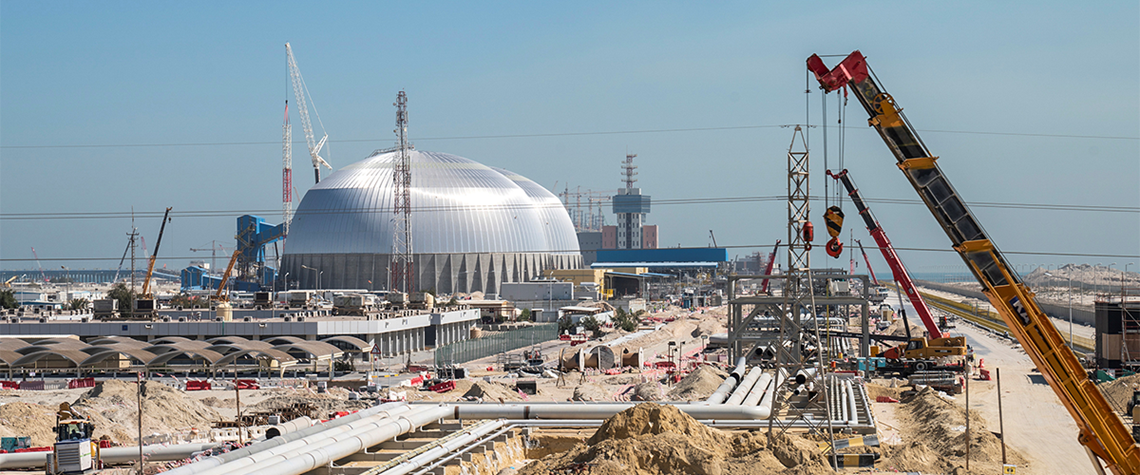
Construction at Kuwait’s Al Zour refinery in 2020
Refining Report: Major projects under way in Middle East
Countries in the region are expanding plants and building grassroots facilities, with countries in Africa keen to cut their fuel import bills
The Middle East is forecast to add approximately 1.6m b/d of new distillation capacity between 2022 and 2027, according to OPEC. Around 38% of this new capacity is attributed to the startup of Kuwait’s 615,000b/d Al Zour refinery, the region’s largest refining complex. However, several Middle Eastern countries are also investing in new capacity through facility expansions and/or grassroots facilities. These projects not only include increasing distillation capacity but also boosting secondary unit capacity by 3m b/d by 2028. Most secondary unit capacity additions (more than 2m b/d) will be in new desulphurisation units to produce high-quality, ultra-low-sulphur (ULS) fuels for both domestic

Also in this section
29 April 2026
The UAE’s exit from the alliance marks a decisive step towards a world in which oil markets are shaped less by collective management and more by national strategy
29 April 2026
Trafigura’s $1b prepayment agreement confirms African resource holders’ renewed interest in oil-backed financing deals as they look to capitalise on high oil prices
29 April 2026
The UAE’s departure from the oil producers’ group was a surprise to many, but the move can be traced back to a single point five years ago
28 April 2026
Oil traders warning of $200/bl oil are wrong, and the market should be wary of proclamations that the impact of the oil shortage has only begun to be felt and a that a ‘harsh adjustment’ is coming—even for industrialised nations


