


Newsletters | Request Trial | Log in | Advertise | Digital Issue   |   Search
  • Upstream
  • Midstream & Downstream
  • Gas & LNG
  • Trading & Markets
  • Corporate & Finance
  • Geopolitics
  • Podcasts
Search
Related Articles
Outlook 2026: LNG markets and the overhang
A third wave of LNG supply is coming, and with it a likely oversupply of the fuel by 2028
Outlook 2026: The geopolitical weaponisation of LNG
Global gas markets are being reshaped by politics as much as by gas prices and fundamentals. From Washington to Doha, Brussels and Beijing, LNG has become a strategic weapon as much as a commodity
Outlook 2026: LNG’s Pacific FID race heats up – Ramp-ups, rejuvenations and restarts
The US Gulf dominated investment decisions this year, but Asian importers’ concerns over supplier diversity mean the focus is shifting
Explainer: How the EU will wean itself off Russian gas
Questions remain about how the phase-out will be implemented and enforced in practice
Mideast states power up their gas priorities
Saudi Arabia, the UAE and Qatar are ploughing resources into gas—with a growing eye on facilitating domestic use in power and value-added sectors
Arctic LNG comes in from the cold
Beijing now appears prepared to accept discounted Russian LNG, even at the cost of heightened sanctions risk
MENA's gas metamorphosis
Across the Middle East and North Africa, gas is taking an enhanced role in helping build out economies that need to diversify away from crude oil dependence
ADNOC’s Australia avoidance
The Middle East NOC’s decision to exit Santos signals changing rules for Australian gas investors
Fear and loathing in US LNG buildout
Overall gas optimism is blighted by concerns over lingering regulatory and infrastructure hurdles that could hamper expansion of US LNG exports, weaken security and stifle AI ambitions
India’s LNG falling short
More needs to be done to meet the government’s ambitious targets for gas
Australia LNG Woodside TotalEnergies Bunker fuel Transport fuel
Sally Bogle
Perth
23 February 2018
Follow @PetroleumEcon
Forward article link
Share PDF with colleagues

Australia all at sea

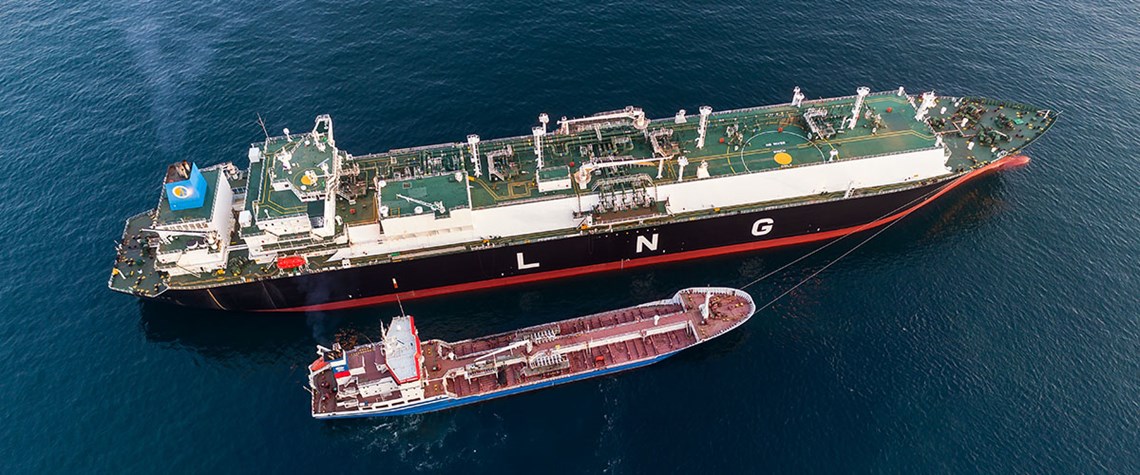
Australia is positioning itself to dominate liquefied natural gas-fuelled cargo shipping routes into Asia

Initially considered marginal compared to alternative fuels, the use of LNG for shipping is rapidly gaining traction. This is partly because of ground-breaking new vessel designs and competitively-priced LNG. But shippers also have an eye on International Maritime Organisation restrictions on sulphur content in marine fuels which will be capped at 5% from 1 January 2020. The game-changing moment came late last year when leading global shipper CMA CGM announced it would build nine large container ships with a membrane tank design by GTT powered by 300,000 tonnes a year of LNG, which would be supplied by Total. This signalled that the shipping industry was comfortable with the concept of burni

Also in this section
Outlook 2026: Grand plan for offshore leasing should give boost to US Gulf
24 December 2025
As activity in the US Gulf has stagnated at a lower level, the government is taking steps to encourage fresh exploration and bolster field development work
Outlook 2026: Revitalising Syria’s oil and gas sector – A new chapter
Outlook 2026
23 December 2025
The new government has brought stability and security to the country, with the door now open to international investment
Outlook 2026: LNG markets and the overhang
Outlook 2026
23 December 2025
A third wave of LNG supply is coming, and with it a likely oversupply of the fuel by 2028
Outlook 2026: Energy realism regains the initiative from energy idealism
Outlook 2026
22 December 2025
Weakening climate resolve in the developed world and rapidly growing demand in developing countries means peak oil is still a long way away

Share PDF with colleagues

COPYRIGHT NOTICE: PDF sharing is permitted internally for Petroleum Economist Gold Members only. Usage of this PDF is restricted by <%= If(IsLoggedIn, User.CompanyName, "")%>’s agreement with Petroleum Economist – exceeding the terms of your licence by forwarding outside of the company or placing on any external network is considered a breach of copyright. Such instances are punishable by fines of up to US$1,500 per infringement
Send

Forward article Link

Send
Sign Up For Our Newsletter
Project Data
Maps
Podcasts
Social Links
Featured Video
Home
  • About us
  • Subscribe
  • Reaching your audience
  • PE Store
  • Terms and conditions
  • Contact us
  • Privacy statement
  • Cookies
  • Sitemap
All material subject to strictly enforced copyright laws © 2025 The Petroleum Economist Ltd
Cookie Settings
;

Search
