


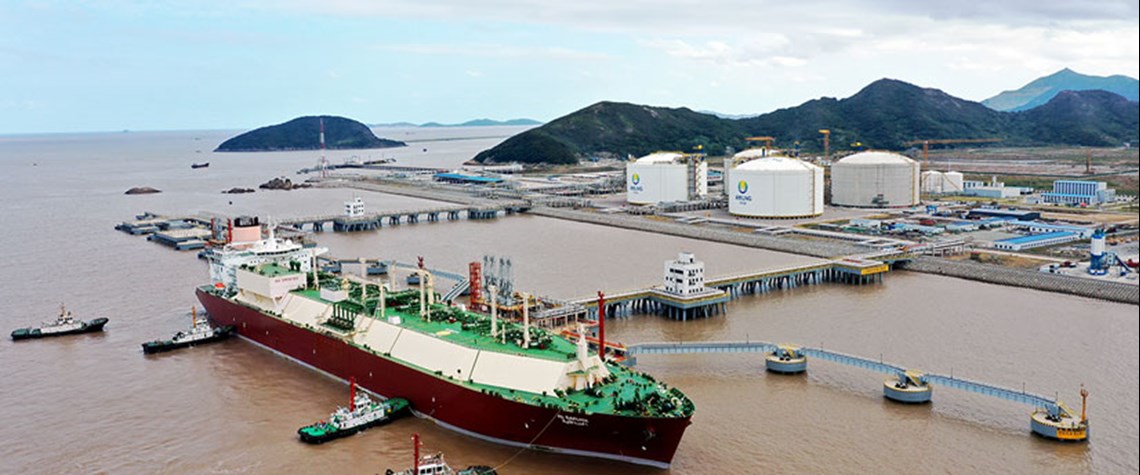
A tanker berths at Zhoushan LNG terminal in east Zhejiang
Chinese LNG dynamics shift
Opening up of market is driving rapid growth in regasification capacity and a change in procurement habits
China is set to bolster its newfound status as the world’s top LNG importer with a massive buildout of regasification capacity this year. But the additional capacity is likely to be underutilised amid insufficient contracting activity and reduced spot market procurement. Up to nine new import terminals and four expansion projects at existing facilities are set to be commissioned this year, potentially adding as much as 38.9mn t/yr of new regasification capacity, according to data compiled by Petroleum Economist. This compares with additions of 13.7mn t/yr last year and 8.9mn t/yr in 2020. The launch of these terminals and expansions—all of which are under construction—stands to bring China’s

Also in this section
2 April 2026
Alongside a rapid continued build-out of renewables, China’s latest five-year plan stresses the value of domestic hydrocarbon production for energy security and calls for increased Russian gas imports
2 April 2026
The government is taking important steps to revive domestic production, lift investment and benefit from the geopolitical crisis even if more needs to be done in the longer term
1 April 2026
Golden Pass’s startup offers QatarEnergy a timely boost but may also force a difficult choice between honouring disrupted contracts and capitalising on soaring spot LNG prices
1 April 2026
It is not a case of if or when, but the length and magnitude of economic damage from elevated oil prices


