


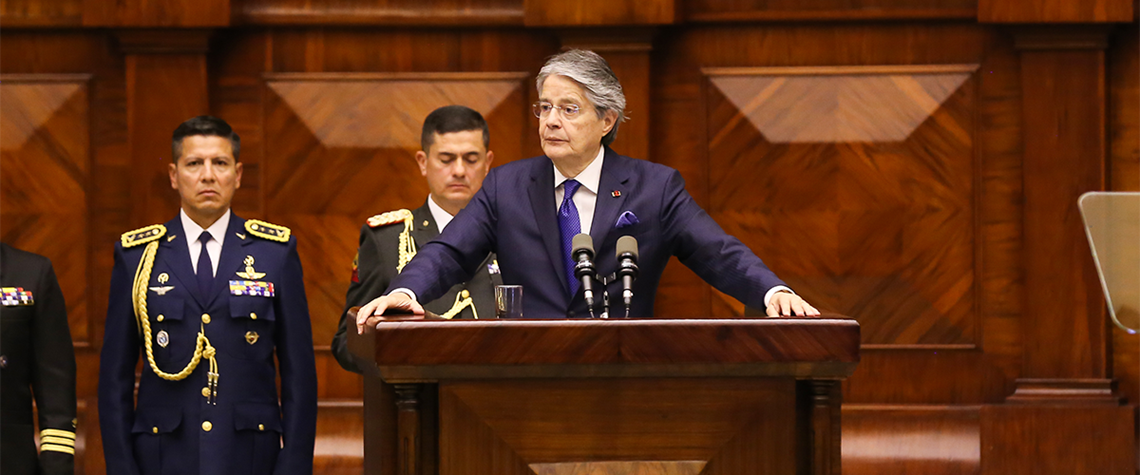
President Lasso speaking during a session of the National Assembly in May in which opposition deputies tried to start impeachment proceedings against him

Letter from South America: The rise and fall of Ecuador’s oil industry
Uncertain whether political change would change Opec member’s energy fortunes
Ecuador, once regarded as an island of tranquillity in a troubled sea, has recently begun to resemble its neighbours in terms of instability. Sadly, the only thing that seems to remain predictable is the decline in oil production from the erstwhile Opec member. Current president Guillermo Lasso had been focused on increasing production and investment in the oil sector, but those policies are in question following his use of a constitutional rule known as ‘muerte cruzada’, through which he has dissolved Ecuador’s National Assembly to avoid potential impeachment. Lasso’s inability to finish his term may portend a more dramatic trend in Latin America in general. As electorates in the region are

Also in this section
24 March 2026
It is an unusual story of out with the new and in with the old, as America First Refining shows the US going back to trusted energy security developments
23 March 2026
A complex and sometimes contradictory web of factors that include unpredictable oil prices, the globalisation of LNG markets, the expansion of Middle Eastern sovereign capital and the growth of datacentre demand will shape the energy landscape beyond 2026
23 March 2026
The Strait of Hormuz crisis highlights how key waterways can become global chokepoints
20 March 2026
Attacks on key oil and LNG assets across the Gulf mean a prolonged supply disruption, with damage to Qatar’s export capacity undermining confidence in the global gas system


