


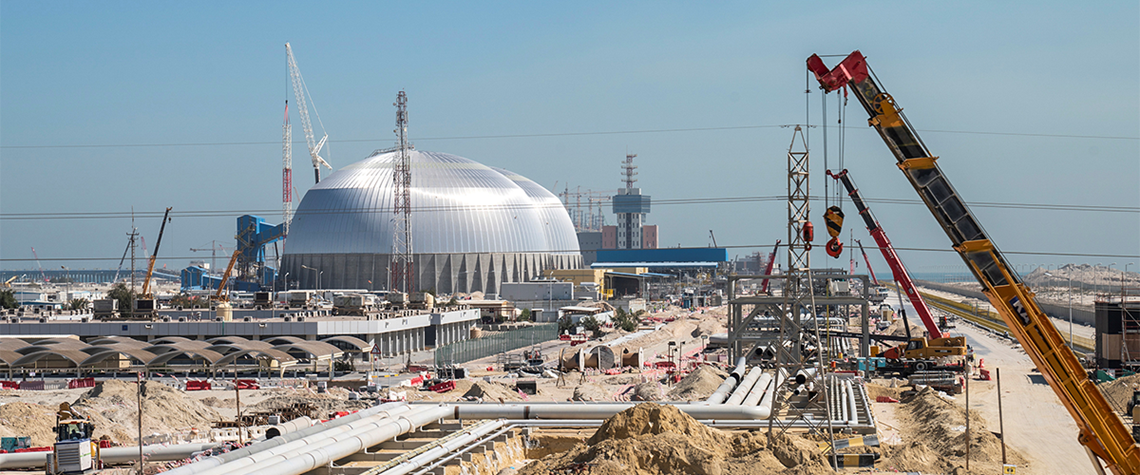
Construction at Kuwait’s Al Zour refinery in 2020
Refining Report: Major projects under way in Middle East
Countries in the region are expanding plants and building grassroots facilities, with countries in Africa keen to cut their fuel import bills
The Middle East is forecast to add approximately 1.6m b/d of new distillation capacity between 2022 and 2027, according to OPEC. Around 38% of this new capacity is attributed to the startup of Kuwait’s 615,000b/d Al Zour refinery, the region’s largest refining complex. However, several Middle Eastern countries are also investing in new capacity through facility expansions and/or grassroots facilities. These projects not only include increasing distillation capacity but also boosting secondary unit capacity by 3m b/d by 2028. Most secondary unit capacity additions (more than 2m b/d) will be in new desulphurisation units to produce high-quality, ultra-low-sulphur (ULS) fuels for both domestic

Also in this section
2 April 2026
Alongside a rapid continued build-out of renewables, China’s latest five-year plan stresses the value of domestic hydrocarbon production for energy security and calls for increased Russian gas imports
2 April 2026
The government is taking important steps to revive domestic production, lift investment and benefit from the geopolitical crisis even if more needs to be done in the longer term
1 April 2026
Golden Pass’s startup offers QatarEnergy a timely boost but may also force a difficult choice between honouring disrupted contracts and capitalising on soaring spot LNG prices
1 April 2026
It is not a case of if or when, but the length and magnitude of economic damage from elevated oil prices


